Faith & Worship · A guide for choristers
The Sung Eucharist
Follow the service from gathering and listening to thanksgiving, Communion and being sent out.
Eucharist means thanksgiving. Christians gather around Scripture, prayer, bread and wine, remembering Jesus’ Last Supper and celebrating his death and resurrection. Holy Communion and the Lord’s Supper are other names for this service. “Mass” also names the service, and often the musical setting of its recurring texts.
This guide follows the broad pattern of Common Worship. The precise wording, music and position of some items vary. Follow the Abbey’s booklet and the conductor’s directions on the day.
1. We gather
An entrance hymn or other music gathers many individuals into one worshipping community. The greeting, preparation and prayers of penitence turn our attention towards God. A collect is a short prayer that gathers the day’s prayer into a particular focus.
Kyrie — asking for mercy
The Greek title means “Lord, have mercy”. The music gives a shared voice to our need for God’s compassion. Listen for the way a composer shapes repetition: each return can deepen a prayer.
Gloria — a song of praise
This hymn praises God, beginning with the angels’ song at Jesus’ birth. In many Anglican services it is omitted in Advent and Lent. A composer may move between brilliant praise and more intimate prayer.
2. We listen and respond
Bible readings, a psalm and the Gospel bring Scripture into the centre of worship. The sermon explores what we have heard. The Creed states the Church’s faith; intercessions pray for the Church, the world and people in need.
For the choir: singing a psalm is a way of proclaiming a text. Understand its sentences, observe the pointing and give its changing mood room to speak. In hymns, help the congregation sing with confidence.
3. We give thanks and share Communion
The Peace expresses reconciliation within the gathered community. Bread and wine are prepared. In the Eucharistic Prayer, the priest leads the Church’s thanksgiving, recalling God’s saving work in Christ. The Lord’s Prayer and the breaking of the bread lead towards Communion. Prayers after Communion give thanks for what has been received.
Sanctus and Benedictus — joining in praise
Sanctus means “holy”. Its imagery joins the worship of heaven with the worship of the gathered Church. Benedictus means “blessed” and recalls the welcome given to Jesus entering Jerusalem. These texts form part of the Eucharistic Prayer; a score may present them as separate movements.
Agnus Dei — the Lamb of God
This title means “Lamb of God”. Its prayer asks Christ for mercy and peace, and is often sung around the breaking of the bread. Shape the final request for peace as carefully as the opening phrase.
Anthems and motets
A choir may sing an anthem or motet during Communion or at another appointed point. Its words can illuminate the season or readings. Check where it belongs, when to stand and who gives the entry; the order of service comes before assumptions drawn from a recording.
4. We are sent out
A blessing and dismissal send worshippers back into daily life. A final hymn and organ voluntary may accompany the departure. The service’s thanksgiving continues in care, service and reconciliation beyond the church.
Reading a Mass setting
A concert recording’s sequence is not a complete order of service. A setting commonly contains Kyrie, Gloria, Credo, Sanctus, Benedictus and Agnus Dei, but composers and performances may omit movements. At the Abbey, the music list and service booklet show which are sung.
Try Victoria’s Mass music: notice how a single prayer can pass between several voice parts. Explore Mass settings in the Musical Toolkit.
A little history
An ancient meal; many musical voices
Remembering and serving
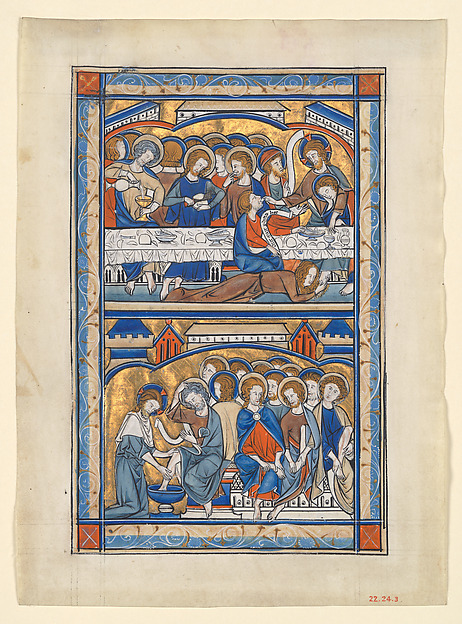
The Eucharist’s story reaches back to the New Testament accounts of Jesus’ Last Supper. This medieval artist places the meal beside the washing of the disciples’ feet: worship and humble service belong together. The picture is a thirteenth-century interpretation, not an eyewitness record of the meal.
Old words in changing languages
For centuries, the Latin Mass shaped worship and music in western Europe. The Kyrie preserves Greek words within that Latin tradition. The English Reformation brought a major change: the first Book of Common Prayer, published in 1549, provided worship in English. Further revisions followed; Common Worship is now used alongside the Prayer Book.
Why do we still sing Latin?
Musical settings carry these texts across centuries and national borders. Singing Victoria or Mozart connects today’s choir with earlier generations of church musicians. A Mass setting is not tied to just one day: its recurring words can be heard afresh in a new season and a new place.
Look, then listen: find the hands in both scenes. Which hands receive, share or serve? Before singing Agnus Dei, think about how a request for peace might be carried in your tone.
Collect — gathering the prayer
A collect is a short, focused prayer. The collect of the day expresses a theme of the Sunday or festival; listen for what it asks of God and how it ends.
Creed — the Church’s faith
A creed is a shared statement of Christian belief. The Nicene Creed is commonly used at the Eucharist; the Apostles’ Creed is used at traditional Evensong. Credo is Latin for “I believe”, and names the Creed in a Mass setting.
The Lord’s Prayer
This is the prayer Jesus taught his disciples, found in Matthew 6.9–13 and Luke 11.2–4. Its petitions turn us towards God’s kingdom, daily needs, forgiveness and deliverance. Different authorised wordings are used; follow the service booklet.
Sources and service texts
Church of England: Holy Communion; the structure of the celebration; planning and preparing Holy Communion.
These are explanations for choristers, rather than a replacement for the authorised liturgy or the Abbey’s current service booklet.
Explore the Music Library · Browse all topics · This week’s music
One thing to carry into worship
As the service moves from listening to thanksgiving and Communion, notice one phrase that stays with you. What might it invite you to remember or do?